

Milan aims to create districts where urban green spaces are designed to maximize their environmental, economic, and social value, turning climate challenges into opportunities for a more liveable and equitable city.
Within UP2030, the Municipality of Milan has developed two complementary methodologies that strengthen its capacity to plan and assess climate-resilient urban transformation. In collaboration with Fondazione LINKS, the city created an Ecosystem Services Assessment (ESA) based on the open-source InVEST tool to quantify the biophysical and economic value of green spaces. Prioritising urban cooling and carbon storage & sequestration, the approach produces maps and figures that inform planning choices and policy design. Tested at city, neighbourhood, and site (public square) scales, it turns evidence into actionable guidance for urban transformation.
In parallel, together with the Resilient Cities Network (RCN), it co-developed a City Resilience Framework (CRF) Methodology that integrates resilience thinking and governance into planning processes, focusing on strategy development, the urban & neighbourhood scales, and a strong climate lens. The methodology strengthens internal decision-making, supports interdepartmental coordination, and clarifies how projects contribute to resilience objectives—helping translate policy intent into project design and delivery.
Together, these prototypes support evidence-based and adaptive planning, embedding climate resilience into everyday municipal practice.



-
-
- Test solutions at multiple scales:
- Street/square scale(de-paving intervention)
- Neighborhood scale (urban transformation project)
- Urban scale (citywide green infrastructure)
-


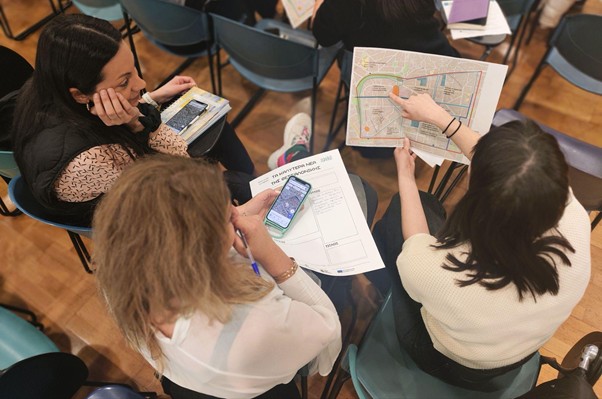
Municipal planners, technical departments, policymakers, researchers, and community partners involved in green infrastructure, sustainable design, and resilience planning.
Impact and Long Term Vision
Through the InVEST and CRF methodologies, Milan bridges technical analysis and governance, aligning environmental performance with urban policy. The InVEST tool supports data-driven planning and quantifies the ecological and economic benefits of green infrastructure, while the CRF framework embeds resilience into municipal decision-making and interdepartmental coordination. Together, they enable Milan to operationalize its vision of a climate-neutral, inclusive, and adaptive city by 2030, providing a transferable model for other European municipalities pursuing integrated, nature-based, and resilient urban transformation.
Development of the "Ecosystem Services Assessment and Methodology" integrating the InVEST tool.

Co-developing based on qualitative methodology.

Funded by the European Union. Views and opinions expressed are however those of the author(s) only and do not necessarily reflect those of the European Union or the European Climate, Infrastructure and Environment Executive Agency (CINEA). Neither the European Union nor the granting authority can be held responsible for them. This project has received funding from the Horizon Innovation Actions under the grant agreement n° 101096405.