

Rotterdam builds on the lessons from the BoTu (Bospolder–Tussendijken) neighbourhood through a Resilient District Toolkit that helps scale just, climate-resilient, and energy-neutral approaches across the city.
Developed collaboratively by Veldacademie, the Municipality of Rotterdam, and the Resilient Cities Network under UP2030, the toolkit captures over five years of research and practice from the BoTu 2028 program. It consolidates 18 practical lessons organised around four steps — Explore, Build, Connect, and Learn — offering guidance for municipal teams, local partners, and communities to strengthen social cohesion, climate adaptation, and energy transition at the neighbourhood level.
Rather than a fixed formula, the toolkit serves as a living framework that supports cities in co-creating resilience through collaboration, learning, and adaptation.
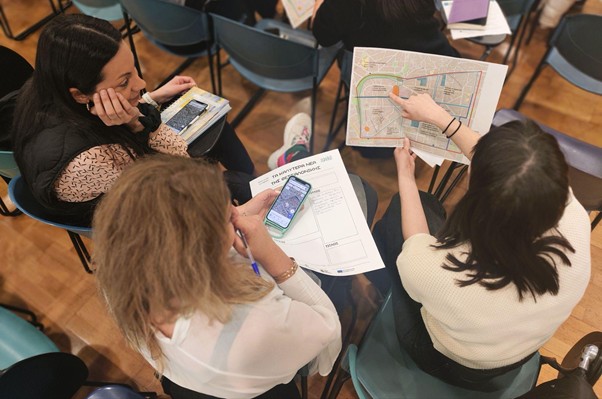
Municipal practitioners, neighbourhood managers, community organisations, researchers, and policymakers seeking practical methods to link social resilience, climate goals, and inclusive governance at the local scale.
Impact and Long Term Vision
The Resilient District Toolkit positions neighbourhoods as essential entry points for urban transitions. It demonstrates that resilience is not a fixed goal but a continuous, collective practice built through long-term collaboration among residents, initiatives, and institutions. By connecting local strengths to broader climate and social goals, the toolkit helps embed resilience into everyday governance and planning processes.
Insights from BoTu are already informing work in other Rotterdam neighbourhoods, showing how knowledge and practices can travel while remaining locally grounded. As funding cycles end, sustaining resilience will depend on embedding these practices within municipal structures and community networks. The toolkit thus lays the foundation for a lasting culture of learning, trust, and shared responsibility, ensuring resilience remains a living process across Rotterdam and beyond.
- Resilient Cities Network
- BoTu 2028 Program
- VUB
- CERTH
- RSPW
- Wijk aan Zet
- Driehoeksplein Team
- Rotterdam Research Group

City liaison and co-developer of the toolkit format.

Core content source, including natural gas-free strategy, local engagement, and energy transition efforts.

Supporting the integration of the NSM.

Supporting the integration of the NSM.

Contributing cases and evaluative insights.
Contributing cases and evaluative insights.
Contributing cases and evaluative insights.
Set to lead toolkit development through 2025.

Funded by the European Union. Views and opinions expressed are however those of the author(s) only and do not necessarily reflect those of the European Union or the European Climate, Infrastructure and Environment Executive Agency (CINEA). Neither the European Union nor the granting authority can be held responsible for them. This project has received funding from the Horizon Innovation Actions under the grant agreement n° 101096405.