

Thessaloniki developed the Dioikitirion District Climate Action Plan (DCAP) within the UP2030 project, aligned with the city’s Climate City Contract. The DCAP outlined a pathway for transforming one of the city’s most central and historic neighborhoods into a climate-neutral, resilient, and inclusive urban area.
Dioikitirion faced pressing environmental, infrastructural, and social challenges due to its dense urban fabric, aging infrastructure, and exposure to climate risks. The DCAP responded through integrated interventions that linked environmental sustainability, social inclusion, and urban livability, reimagining how public space, energy, and mobility systems operate and how residents participated in shaping their neighborhood’s future.
Developed through an inclusive and data-driven methodology, the plan merged participatory processes with advanced digital modeling tools. Following the UP2030 framework, the process was structured around five pillars - Update, Upskill, Upgrade, Upscale, and Uptake - ensuring coherence between local priorities and European climate objectives. Through this approach, Dioikitirion became a model for equitable climate transformation in dense, historically layered urban districts.
A broad coalition of stakeholders — including municipal departments, academia, civil society, and community groups — participated throughout the process. Early engagement with residents helped identify local needs, barriers, and opportunities, forming the basis for a shared vision. As part of the adaptive pathways process, the local community actively contributed by proposing specific actions across thematic areas such as mobility, energy, green infrastructure, and waste, reflecting the everyday needs and priorities of residents.
Co-created through dialogue, future scenario-building, and collaborative design, the plan reflected both lived experiences and professional expertise. Ultimately, the DCAP for Dioikitirion demonstrated how climate action can be localized, democratized, and scaled, serving as a replicable model for neighborhood-level climate transformation and offering valuable insights for other districts in Thessaloniki and beyond. While rooted in the specific context of Dioikitirion, its methodology and insights were transferable, offering a blueprint for other neighborhoods across the Thessaloniki metropolitan area working toward climate neutrality from the ground up.




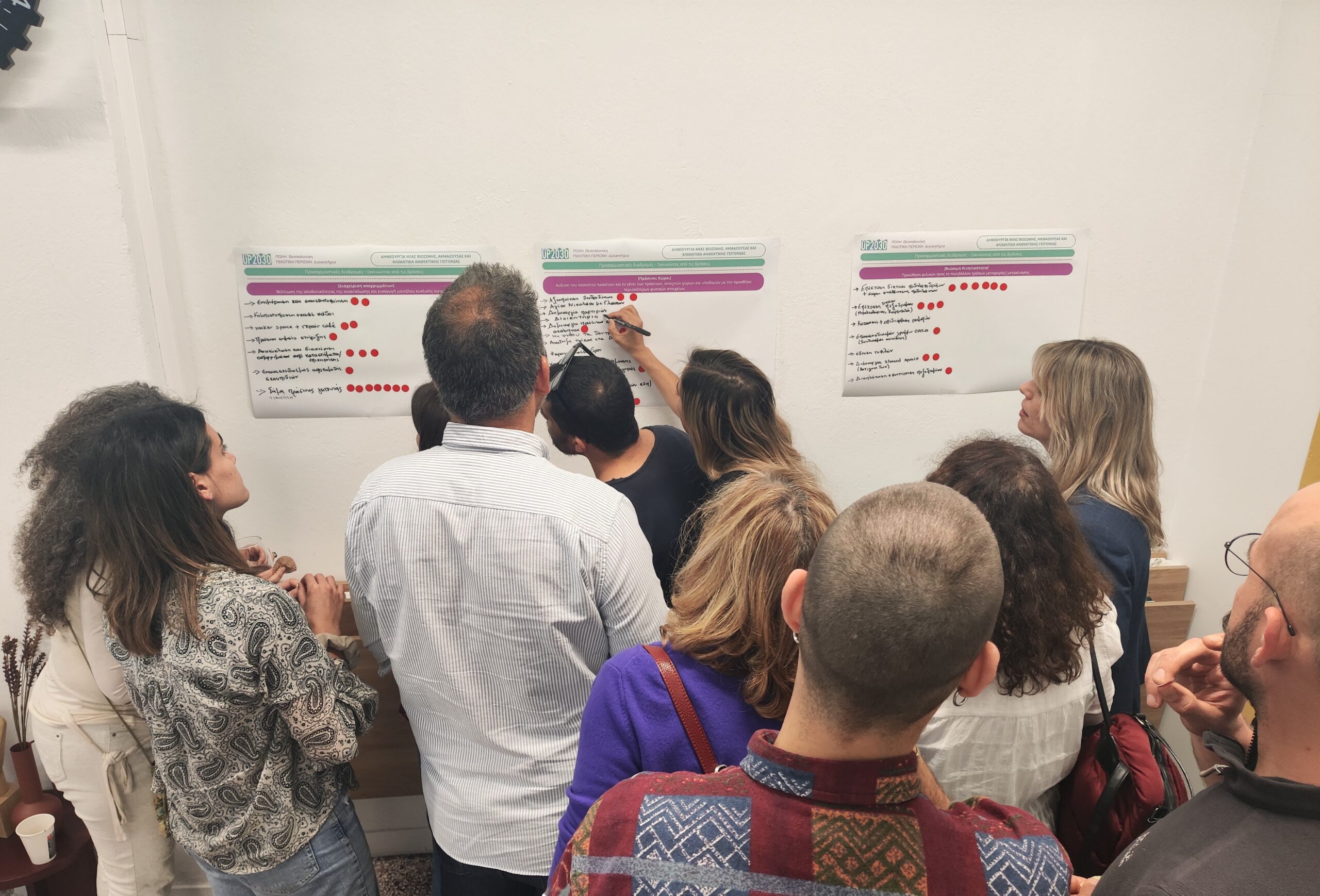
Local residents, small business owners, students, civil society groups, urban planners, and municipal decision-makers engaged in sustainable urban regeneration and climate action.
Impact and Long Term Vision
The Dioikitirion DCAP served as a replicable model for neighborhood-scale climate action, demonstrating how local initiatives drove broader change. It strengthened Thessaloniki’s path toward climate neutrality by 2030, promoting sustainable mobility, energy efficiency, and inclusive urban design to enhance quality of life and long-term urban resilience.
- Major Development Agency Thessaloniki (MDAT)
- Urban Climate Change Research Network (UCCRN) (UDCW Toolkit)
- DRAXIS (Decision Support System)
- Global Green Growth Institute (GGGI)
- Centre for Research & Technology Hellas (CERTH) (Urban GEM Model)
- Vrije Universiteit Brussel (VUB)
- Centre for Research & Technology Hellas (CERTH) (Neutrality Story Maps)

Leading stakeholder engagement, spatial analysis, and co-design methodology.
Delivering simulation-based planning for adaptation and mitigation scenarios.

Providing geospatial intelligence on housing, energy, and demographics.
Assessing green economic pathways and affordability solutions.

Assessing green economic pathways and affordability solutions.

Empowering community storytelling and enhancing climate literacy.
Empowering community storytelling and enhancing climate literacy.

Funded by the European Union. Views and opinions expressed are however those of the author(s) only and do not necessarily reflect those of the European Union or the European Climate, Infrastructure and Environment Executive Agency (CINEA). Neither the European Union nor the granting authority can be held responsible for them. This project has received funding from the Horizon Innovation Actions under the grant agreement n° 101096405.