

Belfast's Net Zero Framework explores what a just and place-based transition to net zero looks like at the neighbourhood level.
Focused on the Linen Quarter and surrounding communities of the Market, Donegall Pass, Sandy Row, and Barrack Street, the initiative provides a replicable approach for integrating climate action, community well-being, and urban transformation.
As a city where buildings contribute 50% of emissions and transport 20%, Belfast faces growing challenges linked to carbon intensity, congestion, and social inequality. The framework helps local authorities, residents, and stakeholders understand how to embed climate goals into daily urban life — from retrofit and greening to active travel and resilience. It also acts as a blueprint for co-designing and scaling net zero neighbourhoods across the city, enabling communities to become central actors in the climate transition.


Urban practitioners, decision-makers, elected representatives, local communities, regional partners, and anyone working toward climate-led regeneration.
Impact and Long Term Vision
The Net Zero Framework offers Belfast a clear, actionable pathway toward achieving its 2050 climate neutrality goal. By linking community empowerment with technical and policy innovation, the city has developed a scalable model that ensures climate action brings tangible improvements in livability and resilience.
In the long term, this framework will guide how area planning, retrofitting, mobility, and green infrastructure intersect to deliver a fair and just transition. Belfast’s commitment to embedding climate action across all local policies positions it as a leader in creating a low-carbon, equitable, and future-ready city.

Developed the "Safe Routes, Healthy Places" toolkit and materials for active travel initiatives such as the Walking Bus.
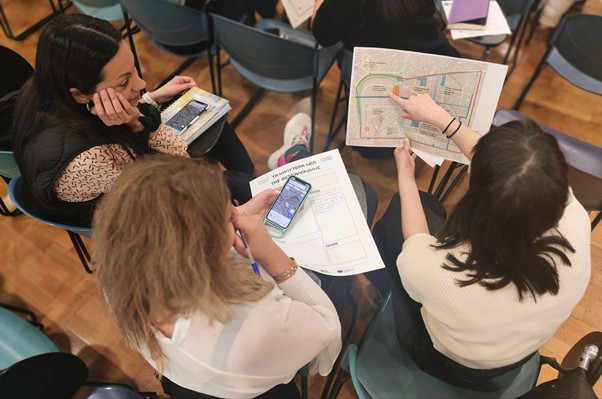
Created Community Maps and provided stakeholder engagement tools.
Delivered a carbon accounting methodology for urban regeneration, estimating emission reductions from greening, retrofit, and mobility improvements.

Advancing Neutrality Story Maps, a multimedia tool for community storytelling and scenario planning to support participatory decision-making.
Advancing Neutrality Story Maps, a multimedia tool for community storytelling and scenario planning to support participatory decision-making.

Funded by the European Union. Views and opinions expressed are however those of the author(s) only and do not necessarily reflect those of the European Union or the European Climate, Infrastructure and Environment Executive Agency (CINEA). Neither the European Union nor the granting authority can be held responsible for them. This project has received funding from the Horizon Innovation Actions under the grant agreement n° 101096405.