Ecosystem Services Assessment

Tool description

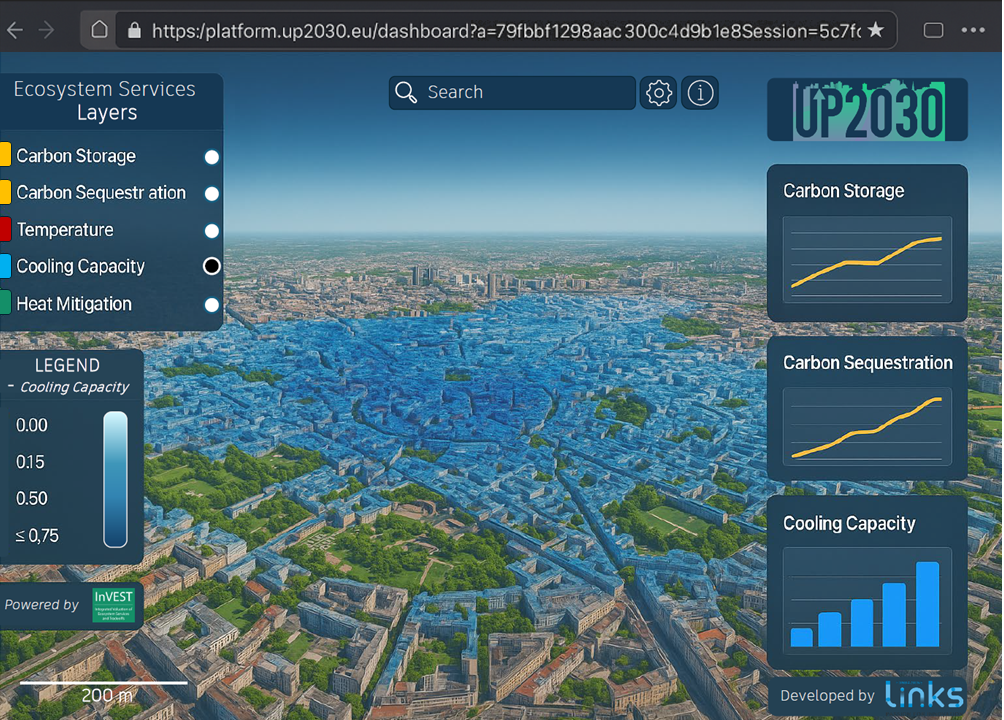
The Ecosystem Services Assessment Tool is a comprehensive operative and technical methodology for the preparation, computation, and delivery of a spatial assessment of ecosystem services provided by environment with a specific focus on urban landscape. The computational framework is based on InVEST, a specialized open-source software developed to identify, quantify, and evaluate the wide range of benefits. It focuses on ecosystem services, which are categorized as regulating services (e.g., air purification, climate regulation), provisioning services (e.g., raw material or food production), cultural services (e.g., recreation, ecotourism, health), and supporting services (e.g., biodiversity and habitat provision).  
The tool supports data-driven environmental planning, helping cities measure their natural capital, understand ecological dynamics, and strategically integrate green infrastructure into urban development processes. By mapping and assessing the state and trends of ecosystems, the tool becomes a key decision-support resource for sustainability, resilience, and well-being. 

Objectives

  • Map and evaluate the condition and benefits of urban ecosystems
  • Quantify the impact of interventions on environmental quality
  • Support decisions with measurable, evidence-based outputs
  • Foster better integration of nature into city planning
  • Inform cross-sectoral policies using environmental data

Expected Impact

  • Informed long-term planning: The tool provides valuable support for the development of long-term urban strategies by functioning as a predictive instrument that facilitates anticipatory thinking. It enables decision-makers and planners to design interventions with a greater awareness of future scenarios, promoting resilience, sustainability, and the efficient allocation of resources over time.
  • Greater recognition of nature's value: By integrating ecological considerations into urban development processes, the tool elevates the perceived value of natural elements within the cityscape. It fosters a deeper recognition of the multiple benefits offered by green areas and environmental initiatives (including their social, economic, health-related, and climate-regulating functions) thereby strengthening the case for their protection and enhancement.
  • More equitable urban environments: The tool actively contributes to fostering more just and inclusive cities by supporting a fairer distribution of nature-based benefits across different neighborhoods. This means addressing existing environmental inequalities and ensuring that access to green infrastructure is not limited to privileged areas, but extended to all urban communities, especially those that are often underserved or marginalized.
  • Smarter investment decisions: By offering a framework for the assessment and comparison of various greening options, the tool enables urban stakeholders to make more informed, transparent, and accountable investment choices
  • Improved institutional coordination: The tool fosters more coherent and integrated governance approaches by encouraging collaboration across departments, agencies, and sectors involved in urban planning and environmental management. It supports the alignment of diverse institutional priorities around common sustainability objectives and helps build a shared language for cross-sectoral dialogue, ultimately enhancing the effectiveness and consistency of policy implementation.

How the tool supports cities' pathways towards climate action?

In Milan, the assessment of Ecosystem Services has played a pivotal role in embedding nature-based thinking into urban planning processes. This analytical framework enables the city to evaluate the carbon sequestration potential of natural systems and their capacity to mitigate urban heat during extreme heatwaves, aligning with Milan’s overarching goals of carbon neutrality and climate adaptation. Furthermore, it allows for the appraisal of ecosystem benefits resulting from urban transformations, offering a basis for establishing shared standards to guide negotiations with developers. These standards aim to ensure that new projects are consistent with sustainability objectives. By leveraging this approach, urban planning becomes more attuned to the specific needs of the territory, fostering design strategies that equitably distribute the benefits of urban transformation, particularly towards areas most vulnerable to climate stressors. 
Partners involved

Contact details

Giulia Melis 

giulia.melis@linksfoundation.com 

Erica Bruno 

Erica.bruno@linksfoundation.com 

TOP Skip to content