

In January 2023, UP2030 came together as a consortium to implement an ambitious project. With a timeline of only three years, we committed to delivering 11 pilot applications in 11 cities to support the socio-technical transitions necessary to achieve their climate targets. Involving analysis, visioning processes, tool implementation, prototype development, and upscaling integration, while the plan was clear, the implementation was less straightforward.
Today, three years later, we are closing the most ambitious project we have coordinated to date, with the satisfaction of a job well done, the joy of having worked with excellent partners, and the lessons learned from collaborating over the past three years.
In this article, we want to share seven highlights from this experience: three that reflect on the relevance and impact of Horizon projects in advancing climate action, and four that focus on multi-stakeholder collaboration and project management as central elements in delivering ambitious research and innovation initiatives.
3 Lessons on Horizon Projects and the implementation of Climate Action agendas
ONE: Urban practices need to move beyond pilot-to-pilot approaches and short-termism
Piloting is central to innovation and change. The problem is that many strong initiatives remain just as pilots: cities often lack the capacity or clarity on what comes next, and upscaling remains an unknown territory despite successful pilot experiences.
In UP2030, cities completed the project with instruments that provided a broader, systemic perspective, and pilot designs that already considered upscaling processes. While challenges remain—particularly in building long-term capacity and securing funding—cities now understand that pilot design criteria must already include an upscaling component. Upscaling is not only a technical matter; it also concerns governance structures, financial sustainability mechanisms and skills—those already in place and those still needed—to ensure that a pilot becomes a meaningful first step toward wider replication.
TWO: The path to systemic approaches is still long
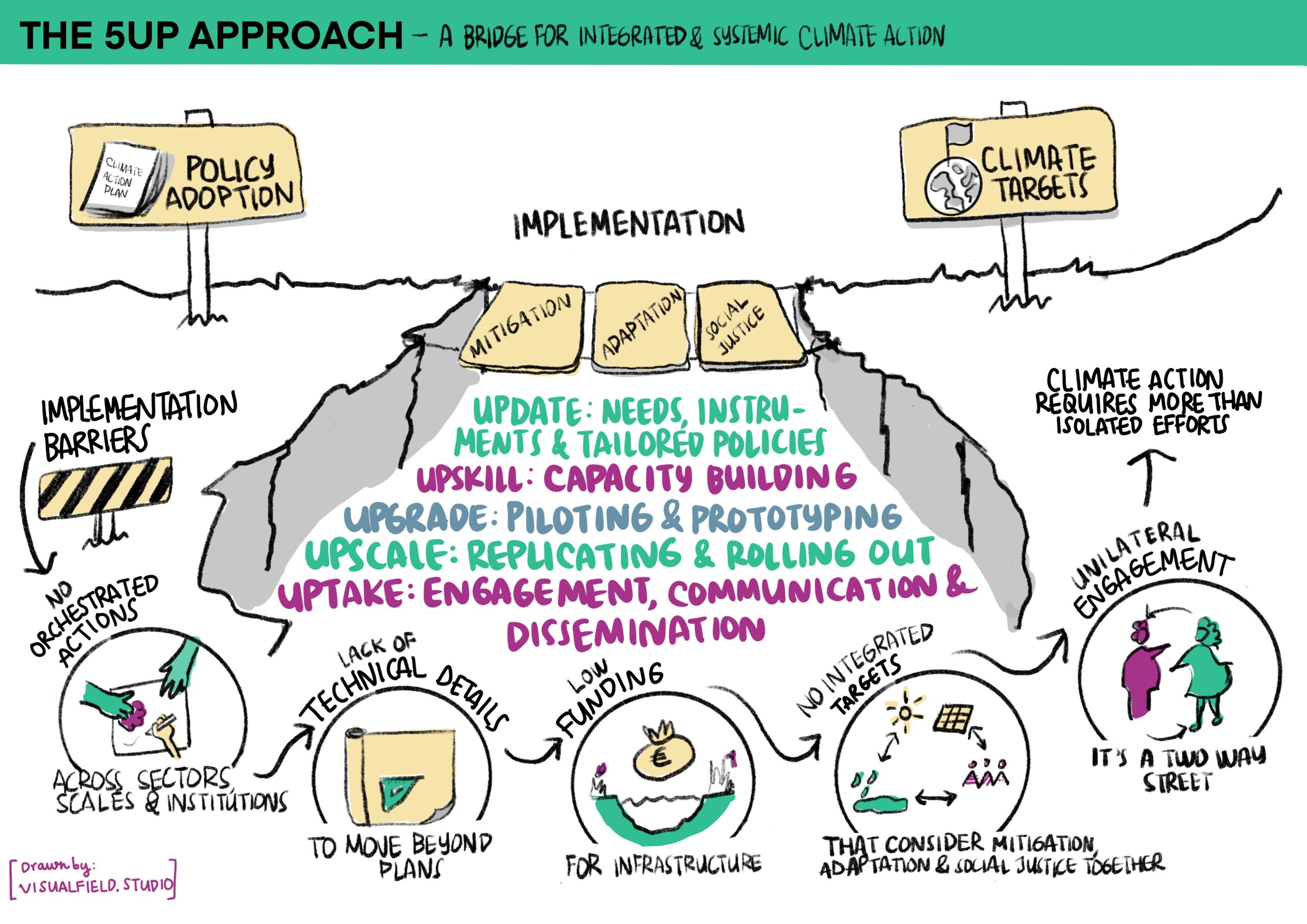
The UP2030 core framework, the 5UP approach, is a systems-thinking model designed to guide cities through the socio-technical transitions required to achieve climate targets (read our scientific paper here). Through this framework, we argue that meaningful climate action must be addressed across at least five dimensions:
- UPDATING city needs aligned with actions,
- UPSKILLING knowledge and agents of change,
- UPGRADING through piloting,
- embedding UPSCALING of actions, and
- UPTAKING key mechanisms and knowledge.
As cities become increasingly aware of climate impacts and while implementation gaps persist, the 5UP approach demonstrated that support must go beyond financing and project outputs. It must also guide capacity building, human agency, prototyping, and upscaling if climate action is to be mainstreamed systemically. It also called for a non-linear and different way of working that often challenged the business as usual at municipalities.
THREE: Climate action must be addressed from three perspectives simultaneously
Climate action is not only about net-zero targets and greenhouse gas emissions. While mitigation is essential, the growing impacts of climate change also demand an equally strong focus on climate resilience, alongside a third project pillar: social and spatial justice. Why? Because focusing on emission reduction strategies may create blindspots and unintended impacts such as gentrification and greenwashing that benefit some groups more than others. Leaving out the needs and voices of communities who already face vulnerabilities due to systemic challenges, only further perpetuates existing inequalities and widens the gaps for their access to better living environments and opportunities that may be leveraged through holistic and equitable climate action. While trade-offs are inevitable, ensuring that actions do not cause disproportionate negative impacts on some groups over the other must be a fundamental consideration.
4 Lessons on Multi-Stakeholder Collaboration and Horizon Project Management
ONE: Alignment
Proposal writing is the moment to identify partner capacities and expertise, but it is often a hectic process. Activities may make sense on paper yet translating them into real-life implementation is another challenge altogether. As part of our proposal, we included a task to be implemented during the first months of the project: the Project Vision Consensus. This exercise allowed us to recognise that the initial work package (WP) structure was not the best fit for the early project phase. Instead, interdisciplinary groups—what we called Task Forces—proved essential to ensuring that the right partners were connected with the right people. With 47 partners involved, it was easy to get lost!
Later in the project, we returned to the WP structure, which made sense once the groundwork had been laid—leading us directly to the second lesson.
TWO: Flexibility
With many partners and only three years to deliver, effectiveness required flexibility. While all cities and tool providers followed the project stages defined in the Grant Agreement—analysis, vision, prototype, upscale—the process looked different in each case. The overarching 5UP framework helped reinforce the idea that climate action implementation must go beyond tools and pilots alone. Needs, capacities, funding, and upscaling are all part of the same package when aiming for meaningful impact.
In UP2030, this resulted in 11 distinct implementation journeys—one for each city (see cities pathways here). By allowing cities and partners to appropriate the process, we achieved stronger outcomes: solutions that made sense locally and instruments that remain sustainable beyond the project’s lifetime. We were delivering but not merely ticking boxes.
THREE: Coherence and relevance of project results
One fascinating aspect of Horizon Europe projects is the sheer volume of results they generate. Too often, however, these results take the form of lengthy deliverables that are difficult to read or engage with—largely because technical complexity and target audiences are not sufficiently considered.
This project pushed us to rethink how we communicate our work: how to make messages accessible and translate technical content into clear, meaningful narratives for a wider audience. This reflection is also an invitation to those designing Horizon calls to encourage alternative formats and move beyond long written documents. Interactive outputs are one effective way to ensure that results do not remain on paper alone.
FOUR: The role of cities in inter-disciplinary collaboration
In such Horizon Europe projects, cities have a dual role to play. The first and foremost is being the spatial and technical context where a variety of ideas and solutions are tested. They bring the real-life cases and engage the mix of local stakeholders which makes our project work tangible and grounded. At the same time, they also play the role of project partners who face the same challenges in grasping consortium dynamics and navigating a mix of tasks that tie directly or indirectly to their pilots. Together with the other tools and advisory partners, they share the responsibility in advancing and achieving project impacts overall. While the spatial-technical ambition for the pilots is defined by the cities at the proposal stage already, our learning after 3 years has been for pilot scopes to be flexible, responsive and adaptive to the project timeline as well. Whether it was the city staff steering the strategic direction of the pilot or the opportunities that the tools or technical partners brought to the discussions, a crucial element has been how open cities have been to adapt their focus while staying true to the initial ambitions defined in line with their overall political or administrative priorities. This openness has led to a rich roster of frameworks, guidelines, platforms, physical interventions and policy recommendations, co-created in unique combinations of city, tool and technical advisory partners.
All in all, the UP2030 experience confirms that Horizon Research and Innovation projects are not only instruments for delivering pilots, tools, or technical solutions, but environments in which knowledge, trust, and capacity for long-term impact are built. Meaningful results emerge only when all actors—cities, researchers, and innovators—engage as project partners with shared responsibility, recognising their different yet equally important objectives. They depend on each other to deliver, and this mutual dependency is what enables learning, replication, and upscaling beyond the project lifecycle. If ambitious climate action is to move beyond isolated interventions, cooperation must be intentionally designed, actively nurtured, and embedded in how projects are structured, delivered, and assessed. Only by treating cooperation as a core condition for success can Horizon projects genuinely contribute to systemic, just, and lasting climate transitions.
Contact:
Catalina Diaz, M.Sc.
Deputy Project Coordinator
Fraunhofer Institute for Industrial Engineering IAO
Catalina.diaz@iao.fraunhofer.de

Funded by the European Union. Views and opinions expressed are however those of the author(s) only and do not necessarily reflect those of the European Union or the European Climate, Infrastructure and Environment Executive Agency (CINEA). Neither the European Union nor the granting authority can be held responsible for them. This project has received funding from the Horizon Innovation Actions under the grant agreement n° 101096405.